In brief
Planning an Odoo ERP project in India? Understand subscription and implementation costs, popular modules, key pricing factors, and how to plan a phased rollout.
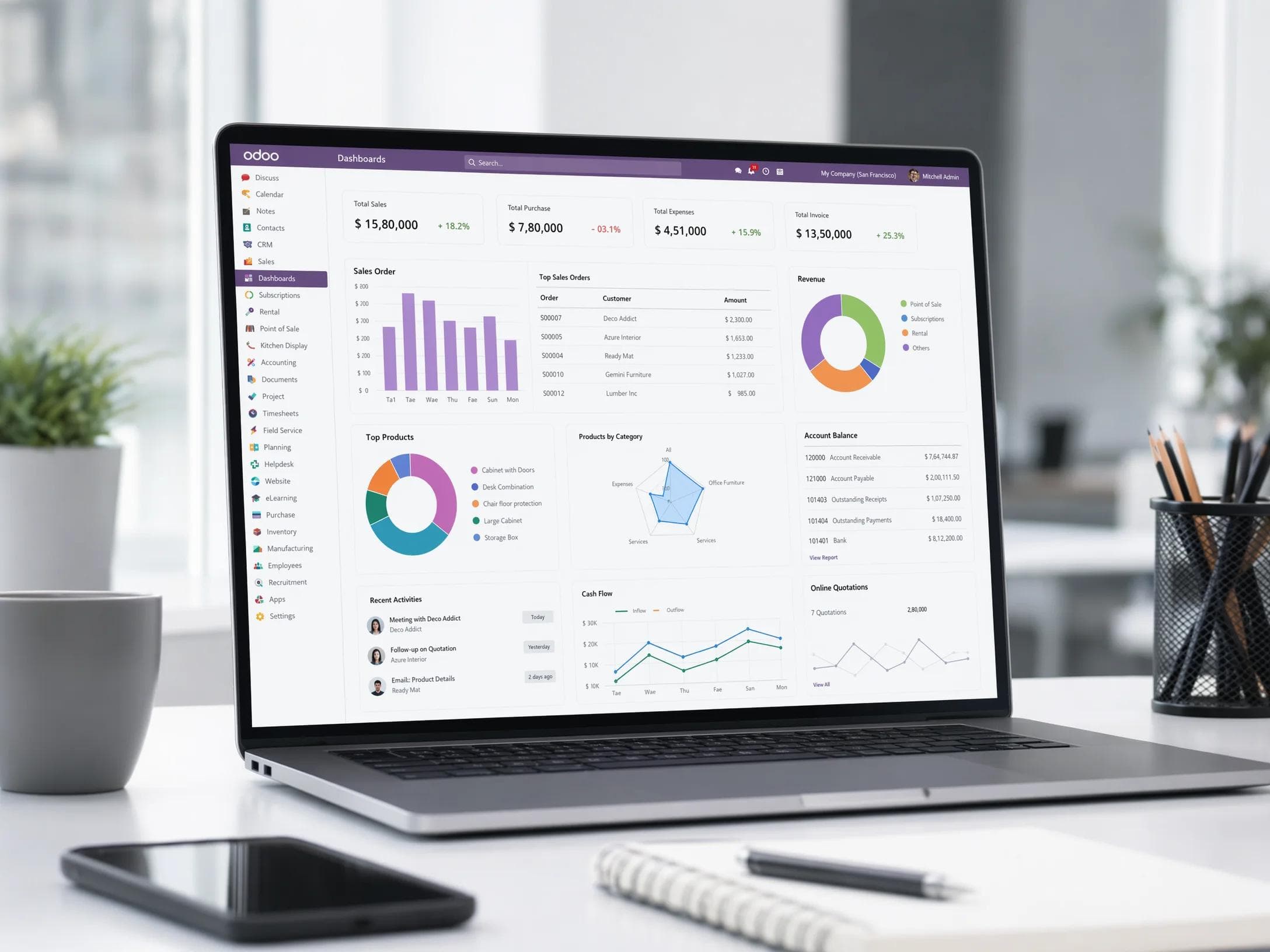
Odoo ERP implementation cost in India depends on more than the software subscription. The number of users and apps, business-process changes, data migration, integrations, training, and ongoing support all affect the total. A small team setting up standard Sales and Inventory workflows has a very different project from a manufacturer connecting production, purchasing, accounting, and multiple warehouses.
There is no single implementation price that fits every business. Use this guide to understand the main cost components, compare proposals on the same scope, and plan a rollout that fits your operations.
What Does Odoo ERP Cost Include?
Separate the software plan from the work needed to make it usable for your business. Ask providers to itemize these costs:
| Cost component | What it may cover | What to confirm |
|---|---|---|
| Odoo subscription or licensing | Access to the selected plan, apps, and users | Plan, billing period, user count, renewal terms, and taxes |
| Discovery and process mapping | Requirements, workflows, and project plan | Workshops, deliverables, and approval responsibilities |
| Configuration and implementation | Company setup, access roles, workflows, and reports | Included apps, business units, and testing environments |
| Data migration | Preparing and importing existing records | Data sources, history, cleanup, reconciliation, and sign-off |
| Customization and development | New features or changes beyond standard setup | Scope, documentation, upgrade impact, and ownership |
| Integrations | Connections to payment, ecommerce, logistics, or other systems | Included endpoints, third-party fees, error handling, and testing |
| Training and launch support | Role-based training, go-live, and early support | Number of sessions, user groups, and support period |
| Hosting and ongoing services | Hosting, backups, maintenance, monitoring, and support | Service levels, security responsibilities, and recurring charges |
Odoo's subscription and its implementation are different parts of the budget. Check the current plan and pricing directly with Odoo, then request a separate, written implementation estimate for your business. Also confirm applicable GST and any third-party or payment-provider fees.
Common Odoo Modules for Indian Businesses
You can start with the apps that solve the most important workflow gaps and add others later. Depending on your business, an implementation may include:
- Sales and CRM: Leads, quotations, sales orders, and customer follow-up.
- Purchase and Inventory: Vendor orders, stock movements, replenishment, and warehouse operations.
- Accounting and invoicing: Invoices, payments, expenses, and financial reporting. Confirm that the proposed setup meets your Indian tax and GST workflows with a qualified advisor.
- Manufacturing: Bills of materials, work orders, planning, and production tracking.
- Project and timesheets: Project tasks, time recording, and service delivery.
- Point of Sale and ecommerce: In-store sales or online orders connected to stock and customer records.
- Human Resources: Employee records, leave, recruitment, and related workflows, depending on the apps selected.
The right module list follows your actual processes, not the largest possible feature checklist. Adding an app may also affect subscription choices, configuration, training, and testing.
What Affects Odoo Implementation Pricing?
Number of users, companies, and locations
User count can affect the software plan, while multiple legal entities, branches, warehouses, or currencies can add setup and reporting work. Confirm which users need full access and how permissions should differ between teams.
Standard configuration or custom development
Configuration uses standard Odoo features and settings. Custom development changes or extends the product to meet a specific requirement. Custom work can be appropriate, but it usually adds design, testing, documentation, maintenance, and upgrade considerations. Ask whether a requirement can be handled through standard settings before commissioning code.
Data quality and migration scope
Importing clean customer and product lists is not the same as migrating years of transactions from several systems. Agree on which records and history need to move, who will clean duplicates, how totals will be reconciled, and who approves the final data.
Integrations and local workflows
Payment gateways, ecommerce stores, shipping providers, biometric devices, and existing accounting or business software may need separate integration work. Clarify the systems involved, available APIs, third-party fees, and who supports each connection after launch.
Training, testing, and support
Teams need time to learn new workflows and verify real business scenarios before go-live. Include role-based training, testing, launch assistance, backups, maintenance, and post-launch support in the estimate rather than treating them as unexpected extras.
Typical Project Scopes to Budget For
Instead of relying on a generic price promise, compare your project against a clearly defined scope:
Starter implementation
A smaller business may begin with a limited set of standard apps, one company, a straightforward user setup, and a focused data import. The estimate should state which workflows are configured and which reports, integrations, or customizations are excluded.
Multi-department rollout
A growing business connecting sales, purchasing, inventory, and accounting will need more process mapping, permissions, migration checks, training, and end-to-end testing. Plan the rollout by department or workflow and identify dependencies before fixing the timeline.
Complex or customized implementation
Manufacturing, several locations or companies, substantial historical data, bespoke workflows, and multiple external systems can require a detailed discovery phase and staged delivery. Custom development, integration maintenance, and future upgrades should be estimated separately.
These are scope examples, not fixed price quotations. Ask providers to estimate against the same written requirements so that the proposals can be compared fairly.
Cloud or Self-Hosted: What Should You Consider?
A hosted subscription can reduce the need for your team to operate infrastructure, but you should still review plan limits, backups, data access, support, and recurring fees. Self-hosting may offer more control over the environment, but your business or provider must plan for server operations, upgrades, security, backups, monitoring, and recovery.
The best option depends on your technical resources, required customizations, data policies, and operational responsibilities. Confirm which Odoo edition, hosting arrangement, and upgrade path a proposal assumes.
Benefits of a Well-Planned Odoo Implementation
When configured around real processes, an ERP can reduce duplicate data entry, connect information across departments, make stock and order status easier to track, and provide more consistent reporting. Shared workflows can also make handoffs between sales, purchasing, finance, and operations clearer.
These benefits are not automatic. They depend on accurate data, appropriate access controls, staff training, agreed processes, and ongoing system ownership. Define what you want to improve—such as order processing time, stock accuracy, or invoice turnaround—and agree how you will measure it before rollout.
How to Keep the Project on Budget
- List the business problems and workflows the first release must solve.
- Identify users, companies, locations, reports, and integrations.
- Separate standard configuration from custom requirements.
- Decide what data and transaction history should be migrated.
- Request an itemized quote that separates one-time and recurring costs.
- Confirm GST, third-party charges, hosting, support, and renewal assumptions.
- Test a representative workflow with users before expanding to more teams.
Questions to Ask an Odoo Implementation Partner
- Which Odoo plan, edition, apps, and hosting option does the proposal assume?
- What setup, migration, integrations, reports, and training are included?
- What is explicitly out of scope, and how are change requests priced?
- Who validates migrated data and signs off on each workflow?
- How are customizations documented, maintained, and handled during upgrades?
- What support, backups, security responsibilities, and recurring costs apply after launch?
Final Takeaway
Odoo ERP implementation cost in India comes from the combination of software, setup, data, integrations, training, and ongoing operations. Start with a defined scope, use standard workflows where they fit, and expand in phases as your team validates the results. A detailed, itemized proposal is more useful than a headline price without assumptions.
At NuiCloud Technologies, we help businesses plan ERP implementations around their workflows and growth needs. Contact our team to discuss your Odoo ERP requirements.
You Might Also Like
 ERP & Education Technology
How Much Does College ERP Software Cost in India in 2026?
8 min read
 AI & Automation
How Small Businesses Can Use AI in 2026: Practical Use Cases and Safe First Steps
5 min read
 AI & Automation
What Is the Cost of AI Development in India in 2026? Chatbots, Automation & Custom AI
8 min read